
Call our team
01484 442420Find An Applicator
Menu
close
With the weather warming up, tradespeople across the country will be remembering just how hot their van gets in high temperatures. But it doesn’t have to be that way. In this post, we’ll discuss insulating a van for hot weather, including why it matters and how it’s done.
Insulating a van for hot weather might seem trivial. After all, most vans have decent air conditioning – and you can always open a window when you’re on the go.
Unfortunately, your own comfort isn’t the only issue – and the options above have their own problems. Firstly, both options increase fuel consumption. Air conditioning uses fuel, while open windows increase air resistance so your van will use more fuel to get where it’s going.
A study by the Society of Automotive Engineers suggests that air conditioning reduces fuel efficiency by as much as 25%. Driving with the windows down can be even worse, with air resistance increasing the faster you drive.
But that’s not all. Vehicles can heat up ridiculously quickly in the sun. 21°C becomes 40°C in just 30 minutes, while 30°C rises to almost 50°C in the same timeframe. Those are the kinds of temperatures you can expect while your van is parked up.
Whether you’re a roofer, plumber or decorator, the last thing you want after a job is a muggy van to get into. Even if you’re happy to pay a little more for aircon or drive with the windows down, it’s going to take some time for your van to get back down from 40-50°C to a comfortable temperature.
As well as being unpleasant when you get back in, it could cause problems for your tools – especially anything electrical. Jewson recommends a “dry and cool space without big changes in temperature,” explaining that changes in temperature “can damage your power tools by making the metal or plastic fragile.”
Hot weather can damage your electrical tools much the same way overheating will when using them. Let’s not forget any food or drinks you’ve left tucked away for lunch. Thinking of leaving a window open? With van theft on the rise, you can wave goodbye to your tools altogether.
Installing van insulation can protect your tools, save on fuel and keep you comfortable. So how is it done?
The first areas to tackle are your windows, which are a big contributor to the heat you get inside a van. This is known as a greenhouse effect (named after the way greenhouses work). Because glass is transparent, it lets light shine through which turns into heat. The heat can’t escape via the same means, so it becomes trapped and accumulates inside the space. In a greenhouse, that’s ideal – providing better conditions for growing plants.
But it’s not great when it’s the inside of your van being heated. That’s why insulating a van for hot weather is advisable. Thankfully, vans have fewer windows than cars.
A large sunshade across the windscreen can block most of the sunlight getting into your van. Any rear windows can be tinted to increase UV protection, so you don’t have to continually cover them up. This is a good idea anyway, so people can’t see into the back of your van.
The next step is the main body of the van. Rather than being heated directly by UV rays, this is heated when the van, as a whole, warms up and that heat transfers through to the inside space.
A comfortable room temperature is usually between 20°C to 22°C. So, if the weather outside is warmer than that, it’s only a matter of time before your van starts heating up too. The van will also be warmed up by conductivity, with its primarily metal body getting pretty hot in direct sunlight and passing heat to the load space.
To prevent this, you’ll want to line the inside of your van with an insulative material to stop heat passing through. Unfortunately, many insulation options are unsuitable for vans:
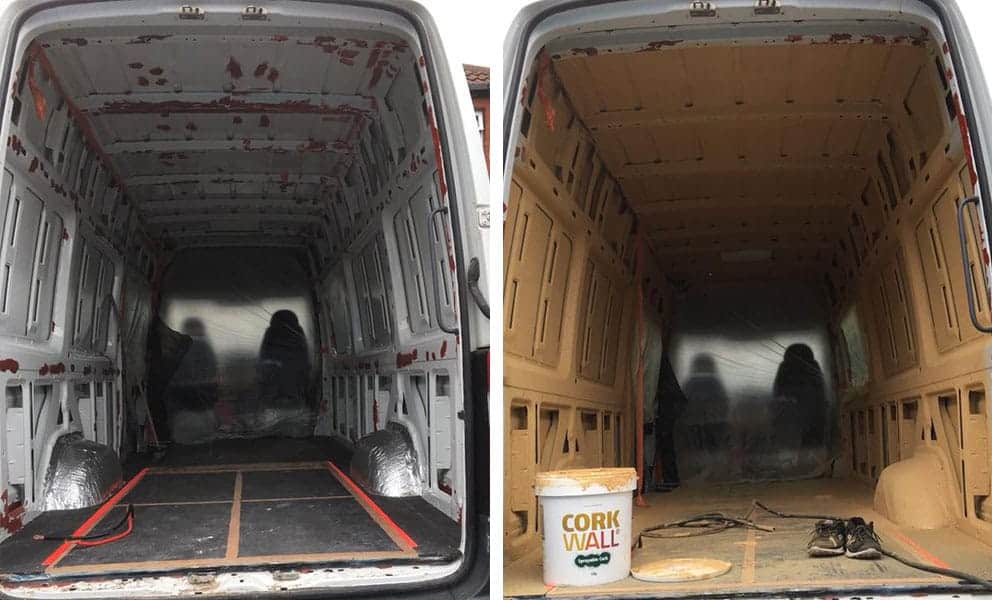
Fortunately, Corksol SprayCork can provide the insulation you need, without sacrificing the load space that’s available. The coating is spray-applied to create a thin, uniform and heat-resistant layer. The spray application reaches every corner of your van’s interiors, ensuring the best insulative performance.
If you want to install van insulation, CorkSol is here to help. We have a network of approved applicators who are fully trained to apply SprayCork to the highest standards. With our help, you can wave goodbye to that sauna experience when you get back in your van after a job, protect your tools from heat damage, and save money on fuel in the long run.
As well as keeping you cool in summer, our van insulation for hot weather will also stop temperatures plummeting inside your van throughout the colder months. That’s an added bonus for comfort and even more money saved when it comes to the cost of van heating while you drive.
Thinking of insulating a van for hot weather? Give us a call on 01484 442420 or email [email protected]. We can provide more information about how the process works and put you in touch with a suitable, approved contractor near you for a quote.
"*" indicates required fields